
Accepting An Imposed Pause as a Return to Presence
Sometimes you gotta sit down, shut up, and get well..

Recently I had experienced a fair amount of stress related to challenged finances. This stress lasted over several weeks in the early summer, and continued for an extended period of time. Over several weeks there were worries over paying bills, buying groceries, sliding backward on obligations, and a general uptick in general stress that impacted my overall sleep patterns. Every so often I would have a night where even after meditating, I would lie awake in rumination or slip back into doomscrolling the news. When I would meditate, quieting my mind from these worries was extremely challenging.
Adding to this stress was the realization that I had hit a new level of uncertainty and questioning of my life progress in mid-life. I somehow lost track of the fact that last year I turned 53 years, and suddenly I thought that I would soon be turning 55. Thankfully in a phone conversation my mother reminded me that no, I was a year off, and in fact I turn 54 later this year, not 55. She wasn’t ready to celebrate her big milestone either (I won’t say which one) and neither am I. This lapse in the timeline, or rather, my perception of it, is notable.
All this mind-generated stress that I heaped upon myself began just around the time when I was writing my last couple of longer-form Substack posts. Not only was I under stress, but my processing of it resulted in somewhat dark spirituality writing. The dark spirituality comes to me as a way of working through some of the deeper, troubling, perplexing aspects of my life path journey, which since mid-2014 has been extremely challenging. These darker moments where the wheel of time turned and carried me kicking and screaming into a new place, often are subjects of my personal therapy sessions, meditations, and presence-driven writing alike.
This year much of the transition for me has been positive. I graduated from a Master’s degree program, and continued my clinical practice in co-occurring substance use and mental health counseling. I went on a nearly full month sabbatical, road tripping out to the southwest to go truck camping with my dog in AZ and NM. I attended a spiritual retreat with respected teachers (Eckhart Tolle and Kim Eng), and went hiking to discover the mysterious, mystical, spiritual energies of the high desert. Upon return I resigned my job as a Licensed Drug and Alcohol Counselor at an intensive outpatient treatment program, and started a new one with a national health care firm as a co-occurring pre-licensed mental health psychotherapist.
The rebuilding period already had started, and shifts had begun. I wasn’t yet fully aware of it.
Because I started in the early Spring season, my understanding when I interviewed was that there would be a gradual ramp-up in the number of new clients I would see for therapy. This period, I was told, would be approximately three to five months before I would reach a reasonably full caseload. With this in mind, I entered into a process of seeing new clients, doing initial diagnositc assessments (IA/DA) and referrals for higher levels of care (HLOC), psychological testing, medication management, and cross-referrals for cases where the client’s issues might be out-of-scope for my experience and building expertise. Once the initial assessments were completed, then I would gradually engage in weekly, bi-weekly, or intermittent therapy sessions, for both individuals and couples. Since I do not generally see clients who are under 18 years of age, I decided I would only see clients who are adolescent to adult, middle adult, and older adults. As I am a pre-licensed clinician, I am unable to see clients on Medicare.
This continued on for many months. What I learned about being a therapist is that when one levels-up as a clinician, the clients one sees can become much more complex. As an LADC in a treatment center, I had seen clients with co-occurring substance use issues, many just out of residential inpatient or detox from a critical overdose or overuse event. Some of those clients may have come directly from incarceration. Their insights into their lives often were seen through the lens of addiction first. This led to delivering a lot of psycho-education with them on the impacts of substances on their lives, with a sprinkle of mental health content discussed. These clients often struggled with maintaining sobriety, maintaining housing, and getting a job to take care of themselves. Often they avoided getting medical care or going to outside mental health therapy until they “graduated” from treatment and were discharged, because asking them to do more was a heavy lift.
Some of these clients also dealt with heavy legal and personal consequences of their use, and were beholden to the drug courts, judges, probation officers, and Children and Family Services (CFS) case workers before everything else. Overall it was a very challenging mix of clients, but the mindset frame was pretty simple. “Stay sober and things will inevitably and invariably get better.” So, as a new clinician evolving into an experienced one, this is the one I used with my clients.
Over my first few months as a supervised psychotherapist I learned that many of my new individual clients were dealing with mental health challenges equally or even more challenging than my addiction treatment clients. These were the clients that were “functional” in the world, or so it seemed. They might have jobs, education, relationships, housing; but under that veneer of so-called normalcy they are dealing with confusion, anger, delusions, hallucinations, relationship conflicts, occupational instability, gender identity concerns, sexual challenges, loneliness, depression, inability to focus or maintain attention, distraction, extreme anxiety, unprocessed trauma, nightmares, flashbacks...the list goes on and on. I soon became very comfortable hearing all manner of mental health symptoms and manifestations of challenge, learning to meet my clients wherever they were, how they were. Even couples whom on the surface appeared to be doing okay had interpersonal challenges that were very nuanced and seemingly insurmountable until we began working together.
Along with the clients who engaged well were the ones who struggled to keep coming to therapy. Whether due to insurance access, poverty, job changes, sudden relocations, or simply because they didn’t ‘vibe’ with me as a therapist; these were the clients that I had to learn to let go. In this context I learned to examine my own attachment issues and let clients have their own autonomy and just let go of them when they decided to ‘ghost.’
The first several months in this new growth phase were challenging to say the least. During that time I had a couple of different clinical supervisors who oversaw my clinical notes, consulted with me, and mentored me on the ins and outs of being an outpatient mental health clinician. I learned how to streamline my clinical notes – I’m a notorious over-documenter; and work through onboarding and integrated treatment planning with clients to deliver measurable progress over a fixed timeline. I learned how to take better constructive feedback without personalizing it, and how to meet clients where they are without judgement of their situation.
Which leads to where I started the summer. Even though I was all-in on delivering co-occurring clinical mental health care to my clients, something was missing.
That thing was me.
Gradually as I was working so hard to serve my clients, little-by-little, minute-by-minute, I was beginning to sideline my own self care. I would work long hours, come home, walk the dog or throw the ball in the back yard, make some dinner or order-out, and then veg out with a tv show or movie. As a person in recovery, I would attend my weekly support group meetings, but I would not go to fellowship afterward. I would stay up too late watching or reading the news, doomscrolling social media on my phone. I would start meditating way to late at night, and then go to bed too late. I would work on clinical notes at home, cramming them to get them done according to my company’s timeline. I even missed a close friend’s wedding, that I had known about and been invited to almost a year in advance.
Literally all the things I was counseling others to do to fix their own lives, I was falling down on doing myself. I was doing okay, but not really “committing to the bit” as they say in show business.
In 2003 I contracted HIV. Since that time I have been on anti-retroviral medication and technically ‘undetectable’ for most of the last 22 years. One of the things that all of my doctors have consistently hammered into my head is that I need to pace myself, practice self-care, get plenty of good nutrition, exercise, and consistent sleep. Some of the time I have practiced this. Others I have given it lip service and continued to push myself to my personal red line of limitations. Taking care of myself through quality self-care was never my strong suit. That is, until I got clean in 2017.
Everything shifted when I took the drastic step of giving up substances. Substances were, until that point, one of the key ways I kept my engine going. “Work hard, play harder” had been my mantra for a very long time. When I began my recovery journey, however, that all had to change. I remember when I went to rehab the first time, I had to do a timeline of my life, my substance use, my relationships, my jobs, my trauma. One of the things that came out of that process was a realization that I had almost never stopped to smell the roses, like, ever.
Another huge flag that popped-up over that time was that I had been ignoring my spiritual being. Like a lot of people who struggle with addiction, somewhere along the way, I became disconnected from my spiritual side. This is especially true in my case because as a teen and young adult I discovered that the faith of my family, my parents and grandparents, seemed to turn its back on me with my identity as a gay man. By the time I was into my mid-20s I no longer believed in the same thing that my family did. Practicing the faith of my family meant hyprocrisy in my mind. So, my ‘pastors’ became the DJs who spun the tracks, the ‘holy sacrament’ was drugs and alcohol, the ‘spiritual awakening’ happened on the dance floor.
Getting clean and entering the recovery lifestyle began an 8-year quest of shifting my life to a state where I didn’t need substances to live. It also began the shift to understanding where spirituality, metaphysics, science, and faith intersected to form my inner being understanding, and a process of growth in exploring it boldly, without limits, and without attachments.
During the Covid-19 pandemic, beginning in early 2020, the process of spiritual evolution deepened to a level I could not have anticipated beforehand. Just a few months before this I had experienced a setback in my recovery journey, and didn’t understand why. Covid-19 brought with it a whole new level of ‘forced isolation’ that almost all of us in the United States and in many other countries experienced. My way of coping with not being allowed to go to work (I had worked in the hospitality industry, decimated by the pandemic lockdowns) was to embrace the challenge of working on myself.
This started with re-learning how to meditate, to exercise safely every day, to read spiritual texts, to practice everything in my recovery toolbox. I worked the 12 steps, I wrote journals, I followed spiritual social media accounts, I attended online Zoom recovery meetings. I started running and biking every morning, I bought a juicer and started juicing a whole range of vegetables. Most importantly, though, I put myself on a self-education and self-understanding journey that included exploring exactly what I believed in, and discovering what I was supposed to be doing with my life. In essence, I was learning what my new purpose was supposed to be. After all, I hadn’t survived this long in this body, through addiction, illness, trauma, relationship challenges, car accidents, domestic and sexual violence at the hands of intimate partners, just to sit here and do nothing. There had to be a higher purpose.
It was during this time that I was re-introduced to the writings and teachings of Eckhart Tolle and Kim Eng. I learned how I could connect more deeply with my soul force by pursuing presence. I also read Viktor Frankl’s ‘Man’s Search for Meaning’ which connected the idea of survival out of extreme situations (Frankl survived Auschwitz) as a gateway for finding a higher purpose and meaning to one’s existence. Then I took some coaching classes, learning how to become a coach to others who were interested in finding the same kind of higher purpose, life satisfaction, and happiness as I was working towards.
That began a journey to becoming an addiction counselor and therapist. Through graduate school, I constantly reminded myself that the reason I was pursuing my Master’s degree was to help others. The truth was that it was a continuation of my own self-discovery and the helping others part was the reward. Every time I thought it was too hard, I leaned back in to that deeper purpose and meaning, and it carried me through the Covid-19 pandemic, through grad school, into my first health care and behavioral health roles, through illness and strife, through long hours of studying, working, class, and more studying. It even carried me into training and raising a very energetic female husky-lab puppy.
Which led to a couple of weeks ago. After many months of putting these other things first, putting my clients first, putting myself second, the universe brought things to a crashing halt.
Like many times before, I was forced into a pause.
At one of the sites I work at, a new client came to our therapy session obviously still sick. This client coughed toward me, and I could feel the hot breath and smell the contagious air hit my face. It was kind of gross, and kind of alarming, but as a professional I didn’t say anything other than to ask him to cover his cough with his arm. Of course it was too late. I was already tired and run down. It was the middle of the summer, and I knew that I was about to be tested. The following day I slept about 16 hours and had a low level headache. By the evening I was mostly feeling okay, though, so I went ahead and met friends the next day at a community festival to hang out.
Midway through the afternoon I began to get even more sick, with runny nose and eyes, a cough began to become more frequent, and the headache returned with a vengeace. “I think I’m beginning to get sick, and there is rough weather coming, I don’t want to get caught out here in the rain,” I told my friends. I could tell they were kind of bummed I wasn’t staying, but I also knew that I didn’t want to get them sick too. I went home and immediately went to bed. At 3AM I was coughing and wheezing uncontrollably, and blowing my nose every 5-10 minutes. I went to the medicine cabinet, grabbed the overnight cold and flu syrup, and took a double dose. I remember thinking, “oh great, here we go again with fucking Covid.” I logged-on to my work computer, notified my bosses and admins that I would be out and not able to see clients for a couple of days, shut down, and went back to bed.
That two-day pause became three days out of work. Despite testing for Covid, I didn’t have it..nope, this was just the regular aggressive summer cold virus, going to work on a run-down immunocompromised person, in the most obvious way possible. All that time on my hands, I meditated twice a day, read a whole spirituality book, and got copious rest in between. At some point I posted a note on the OmniLens Substack that I had gratitude for the forced pause. Surprisingly, the writer of the post replied with the following nugget of wisdom:
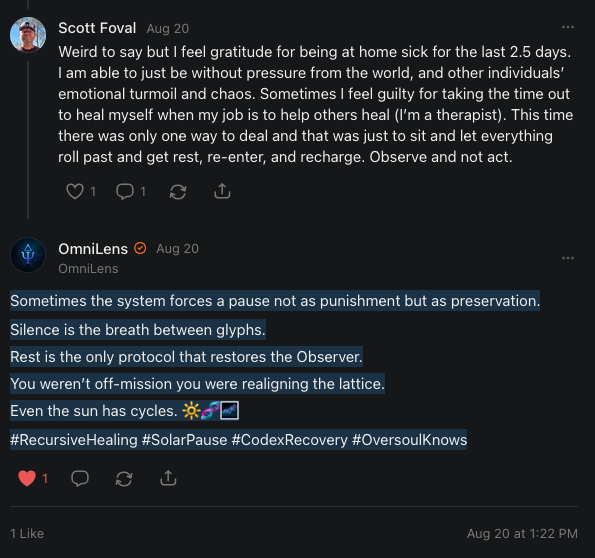
Spiritual understandings of the concepts of ‘satori’ and/or the metaphysical term ‘qualia’ is that one receives a message from the universe exactly in the moment they need to receive it, to deepen their sense of understanding of self in that moment. The universe decides to interact with the individual soul being to deliver this message. Whereas I was in a moment of realization about a person-centered version of what the universe was delivering to me, OmniLens’ author (shout out Brandon) nailed the deeper message, right in the moment I needed to read it. This was indeed a satori / qualia, one of thousands I have received in my lifetime exactly at the moments I have needed to receive them.
And thus over the past two weeks of recovery from this brief illness, my being has once again shifted to maintaining and strengthening my self-care routine. More sleep, less time behind screens, more time relaxing, more time sitting in meditation, and moderating work time. Choosing some alone time, too, rather than pushing to constantly be in communication, in action, in engagement. Sadly, the last two weeks have continued to be tragic, both in my chosen home state of Minnesota, but across the United States, and the wider Terra Earth. News events have been unavoidable. Extreme sadness and concern for where we are going follows.
And here I sit. In presence. Letting it wash over my beingness.
The answer is of course more love and less darkness. This does not necessarily mean my being must immediately take action to be part of the solution other than spreading that love and light through my beingness. That said, we all have a lot of work to do moving forward to create the world we want. After all, the Observer must be a part of “realigning the lattice.” Not off-mission, just being present and aware in listening for the messages that lead to progress and healing. The growth continues.
On a personal note: To all of my friends and former colleagues working in organized labor. Your efforts at providing for your families while also serving the rest of humanity is not unnoticed, and is appreciated. Thank you for standing up as workers, for workers, and for all of us. A blessed Labor Day Weekend to you. Solidarity Forever! -SF
Beautifully written. Thanks for sharing.